
Microsoft Copilot
Careful What You Wish For: One Month working with Copilot Cowork
Cowork is not simply a better AI agent. Its value begins when the work becomes too long, too repetitive, or too connected to other tools to follow up comfortably inside a single conversation.
Imagine you rub a magic lamp and out comes a genie.
The genie tells you that you have a limited number of wishes.
- Ask for something too small and you’ve wasted one.
- Ask for something vague and you may spend hours fixing the result.
- Ask for something enormous and the genie might hire an expensive consultant to fulfill your dream and send you the bill afterward.
After a month using Copilot Cowork, I’ve started to think of it exactly this way.
Cowork is not simply a better AI agent. Its value begins when the work becomes too long, too repetitive, or too connected to other tools to follow up comfortably inside a single conversation.
I’ve spent the past month testing everything from simple content creation to a recurring workflow that reviews and scores the job opportunities arriving in my inbox.
My conclusion is that Cowork is real, useful, and it has potential...after proper guardrails are put in place.
It is also very easy to misunderstand.
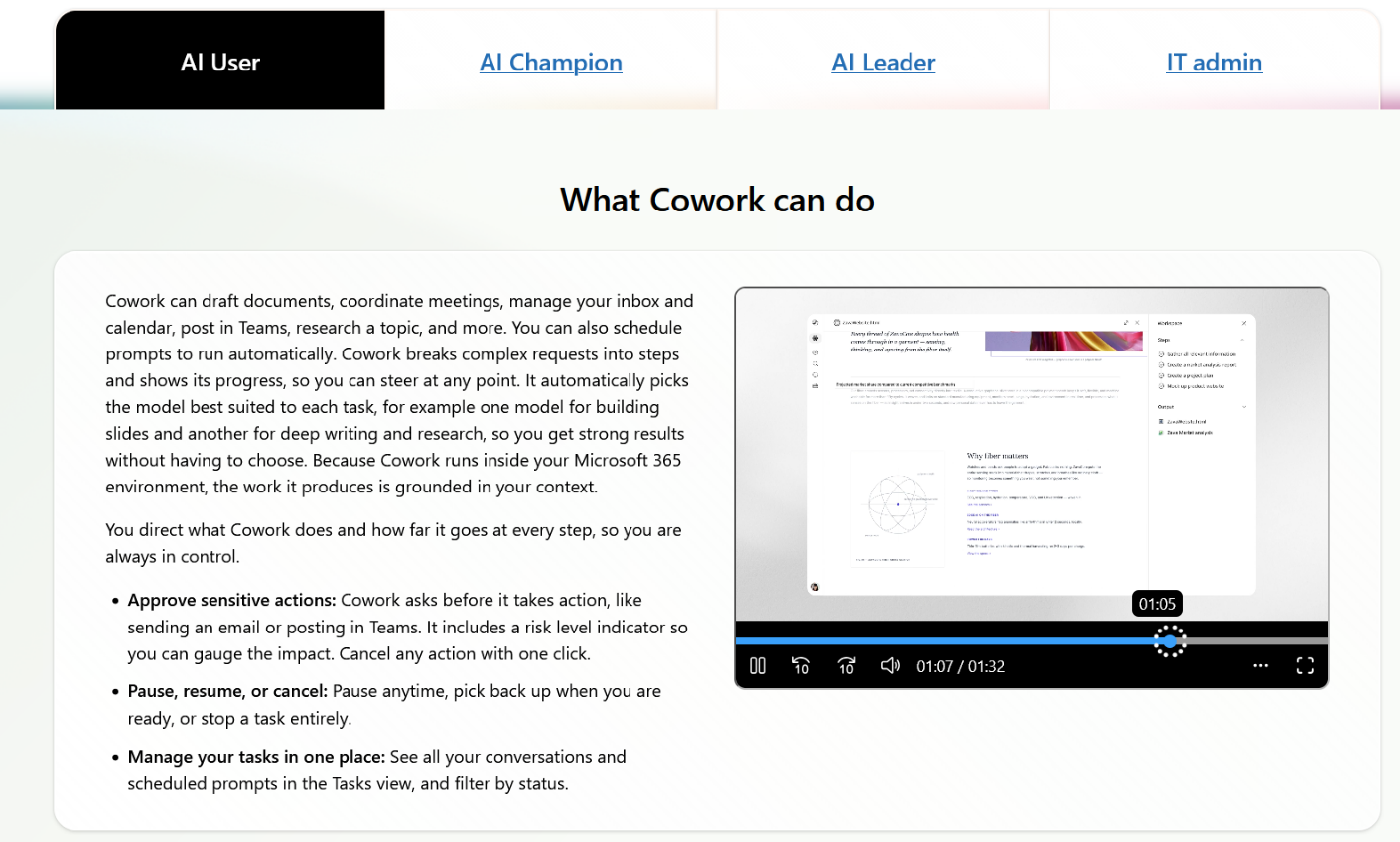
The most impressive thing about it is not that it can generate a document, presentation, or plan. Chat and the in-app Copilot experiences can already do many of those tasks.
Cowork becomes interesting when I can give it an outcome, allow it to work across information and applications, steer it when necessary, and return to something much closer to completed work.
That is a meaningful shift. But it is not magic. And it is certainly not free magic.
When Cowork became generally available on June 16, 2026, the biggest change was not the feature itself. It was the pricing model. Cowork moved from being included under the Frontier program to a consumption-based model built on Copilot Credits.
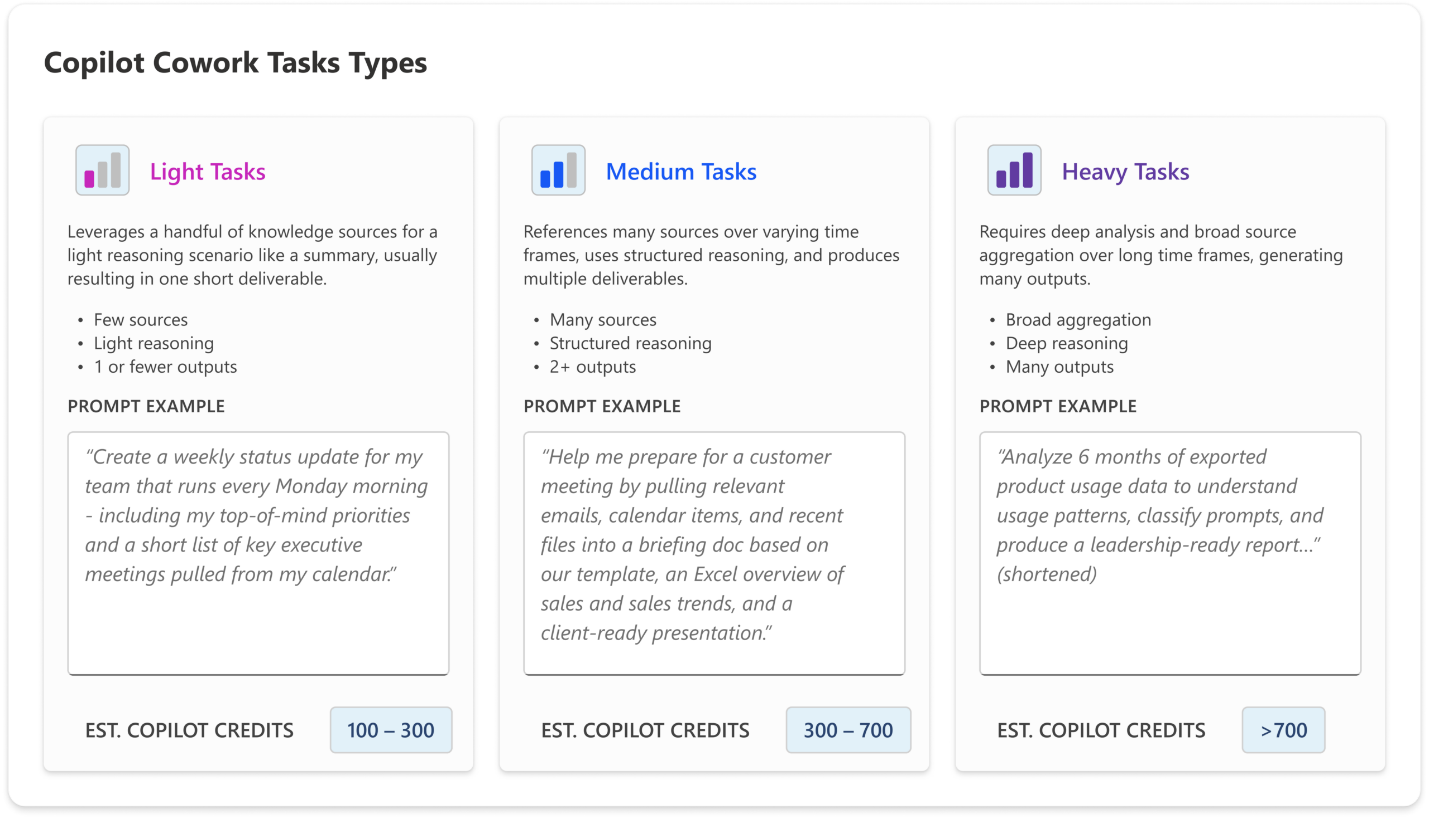
Suddenly, every wish has a cost.
When evaluating Copilot usage costs, consider a Copilot credit is worth $0.01 USD. Under this model, a light task, such as summarizing information from a few sources and producing a single output, typically consumes 100 to 300 credits, resulting in a cost of approximately $1 to $3 per task. A medium task, which involves gathering information from multiple sources, performing structured reasoning, and generating several deliverables, generally uses 300 to 700 credits, costing about $3 to $7 per task. Heavy tasks that require deep analysis, broad data aggregation across extended periods, and multiple outputs consume more than 700 credits, resulting in a cost of more than $7 per task.
Key takeaway: Copilot costs scale with the complexity of the work being performed. The more data, reasoning, and outputs required, the higher the credit consumption and overall cost.
Light Task: Starting with work that Copilot Chat could already do
One of my simpler experiments was asking Cowork to create a presentation covering the updates announced at Microsoft Build 2026 as part of a package for a short contract.
This was useful, but it also exposed an important truth: creating a presentation is not automatically an agentic use case.
To be honest, this felt a little like using one of your wishes to ask for a sandwich.
The task may be valuable, but it is not necessarily worthy of an autonomous agent.
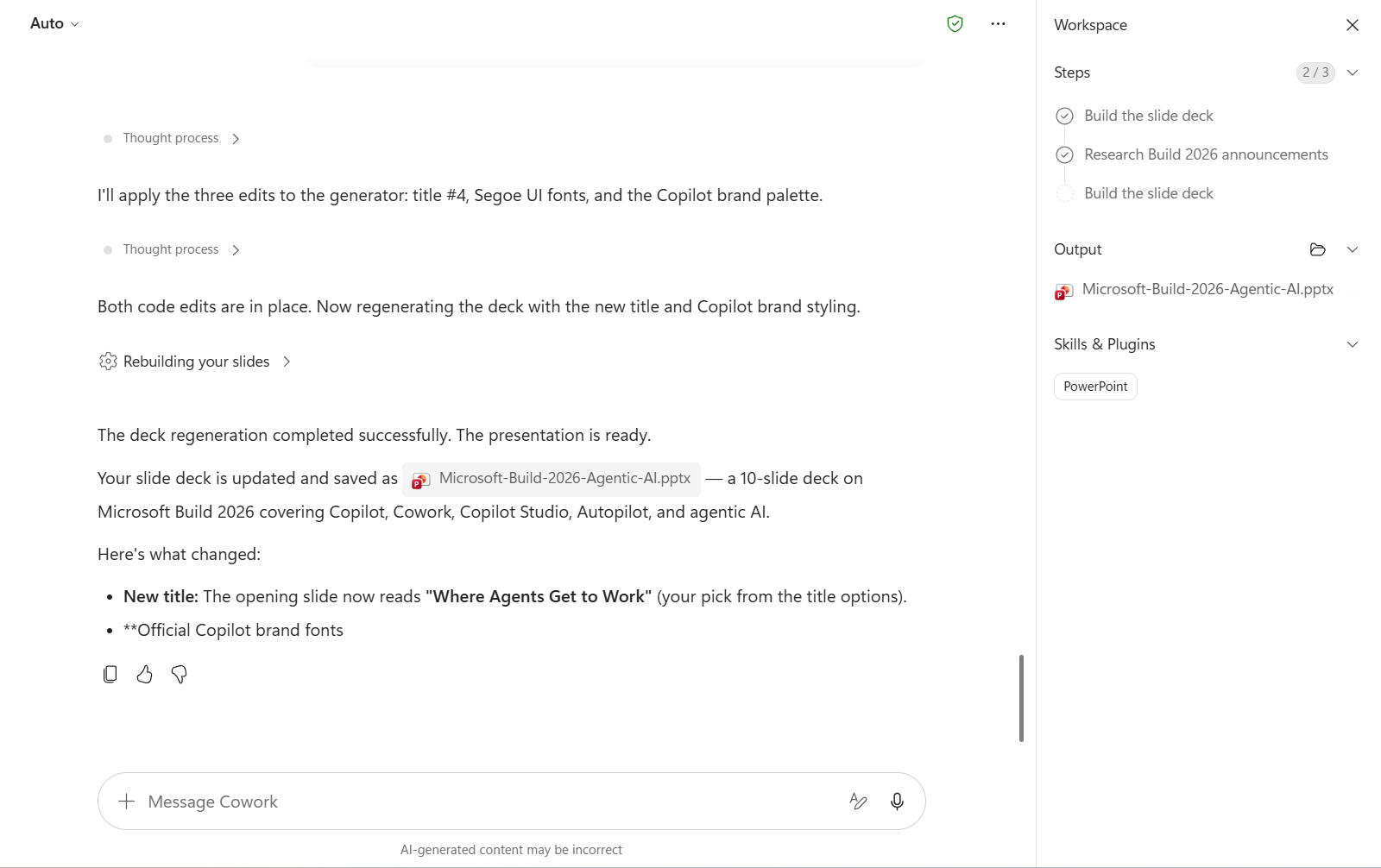
If the work simply involves summarizing a few sources and producing slides, it may be handled just as easily using the PowerPoint agent in Microsoft 365 Copilot or directly inside PowerPoint itself.
Cowork can still complete the task, but the question is whether it should.
For a one-off deck, the answer is probably no. For a recurring executive update that collects information, validates it, builds the deck, and delivers it on a schedule, the answer may be very different.
Medium Task: Moving from an output to a plan
A more ambitious experiment involved asking Cowork to create a three-week Python learning plan and place the learning sessions into my calendar.
This crosses an important boundary.
The output is no longer simply a course outline.
Cowork must translate a goal into a sequence of work, structure the material, account for time, and connect the plan to the place where the work will actually happen.
This is where the wishes become more interesting. The agent is no longer creating an artifact. It is helping you orchestrate an outcome.
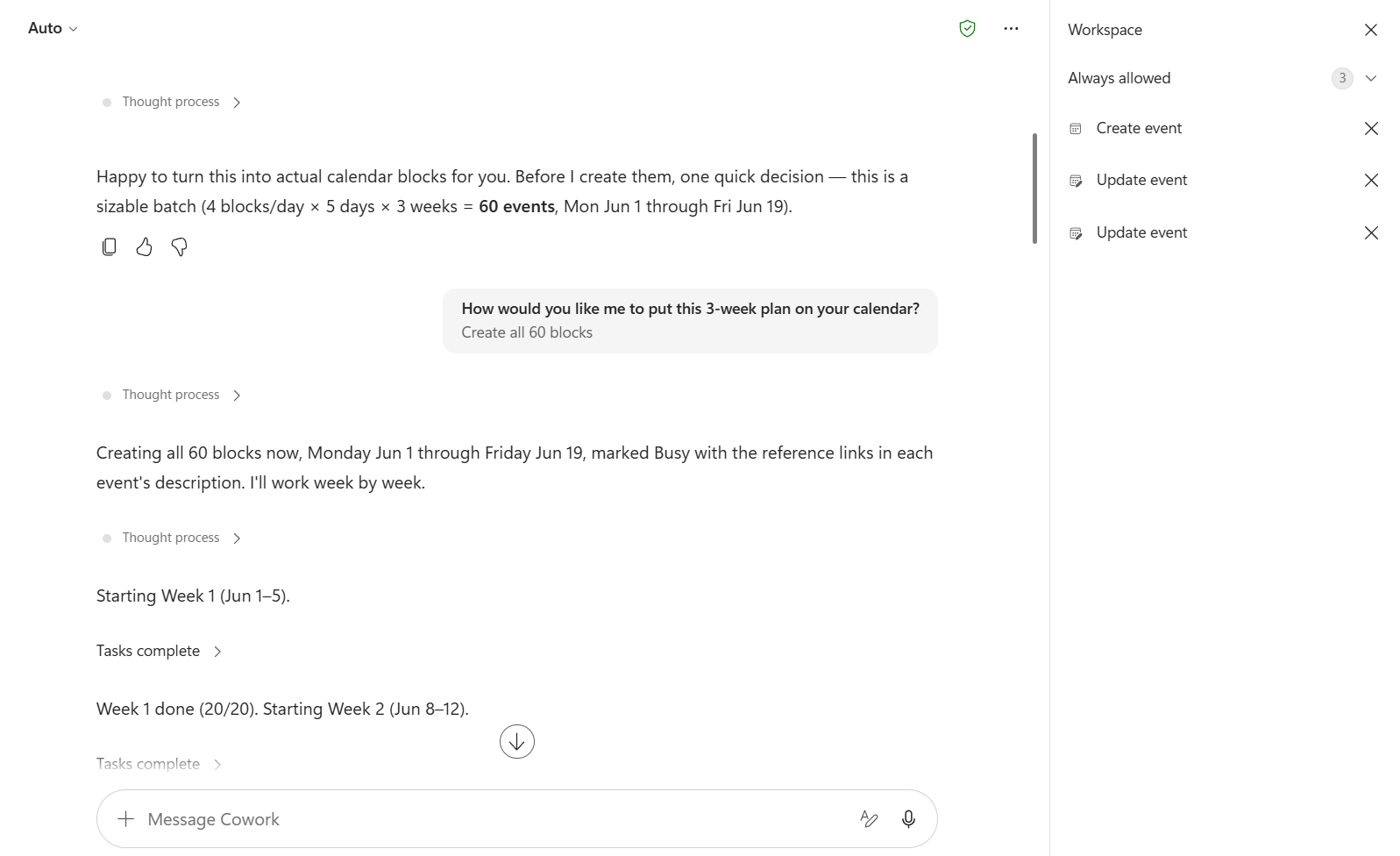
AI value is often described as time saved, but saved time does not automatically become a better result. A course sitting inside a document is only potential value. Scheduled sessions, completed exercises, and demonstrated skills are outcomes.
Instead of asking for one response, I was asking Cowork to help construct a loop:
- Define the learning goal.
- Break it into lessons and exercises.
- Schedule the work.
- Track progress.
- Adjust when reality interferes.
The better I define success, the more useful the workflow becomes.
“Help me learn Python” is vague.
“Create a progressive curriculum, reserve realistic calendar blocks, include exercises, and identify what I should be able to build at the end” gives Cowork something it can plan and something I can evaluate.
Heavy Task: The real test, a recurring reasoning-lead workflow
For months my inbox has been flooded with messages from recruiters and LinkedIn alerts sitting idly. It’s not that I’m not interested, but the amount of information I receive from Microsoft product updates, AI newsletters and job opportunities can become overwhelming at times. This was an interesting and complex enough use case involving Copilot Cowork to review my inbox for job opportunities, compare them against my résumé and LinkedIn profile, score the fit, and filter out opportunities below 70%.
This is much closer to the kind of work Cowork is designed to handle according to the documentation I’ve been reviewing from Microsoft. The workflow has frequency, multiple sources, personal context, decision rules, and clear outputs. It is not simply generating text.
It is performing repeatable assessment work:
- Find relevant messages.
- Extract role details.
- Compare them against experience.
- Apply scoring criteria.
- Remove weak matches.
- Present the strongest opportunities.
The 70% score provides a stopping rule. Without a threshold, I simply receive another AI-generated pile to review. With one, Cowork reduces the field before asking for my attention.
Important distinction: the score is not truth. It is a decision aid.
The quality of the result depends entirely on the quality and freshness of the source material. For that reason, human review remains essential.
What a month with Cowork has taught me
First, the task matters more than the prompt.
Cowork performs best when it receives trusted context and a clear definition of done.
More information does not automatically improve judgment.
Relevant information does.
Second, the best opportunities are workflows, not artifacts.
The document, deck, spreadsheet, or report is often just the final deliverable.
The value comes from connecting the work around it:
- Finding information.
- Reasoning over it.
- Using applications.
- Checking results.
- Repeating the process.
Third, recurring work changes the economics.
Cowork is usage-billed.
Organizations need to understand cost per completed workflow, not cost per prompt.
The all-you-can-eat buffet became a pay-per-plate menu.
And that changes how you think about every wish.
A daily inbox review may be worth paying for if it consistently saves attention and surfaces stronger opportunities.
It is not worth paying for simply because it produces an impressive activity log.
The challenge is that wishes that sound small can become surprisingly expensive.
My job-opportunity workflow sounds simple when summarized:
“Check my inbox and score some jobs.”
In practice, Cowork:
- Read complete emails.
- Identified multiple opportunities.
- Retrieved job descriptions.
- Applied scoring logic.
- Compared several résumés.
- Created tailored documents.
- Updated spreadsheets.
- Sent summaries.
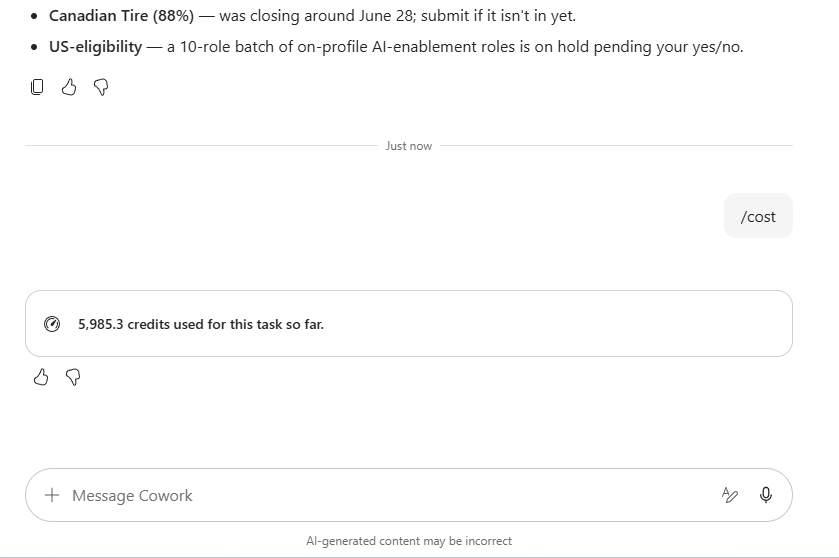
Actual usage: in about a week (~7 successful runs, it failed a couple of times), the final task consumed 5,985.3 credits.
Approximately $60.
That does not automatically make it too expensive. It simply means that our idea of simple vs complex is a poor predictor of cost.
Fourth, autonomy needs controls.
Cowork’s human-in-the-loop model is not friction to eliminate.
It is part of the design.
Permissions, approval boundaries, auditability, privacy controls, and oversight become increasingly important as the work becomes more consequential.
Finally, the metric should be the outcome.
Did the Build presentation communicate the right information?
Did I complete the Python sessions?
Did the inbox workflow reduce noise and improve decision-making?
Those questions matter more than the number of prompts avoided.
Why I would not recommend broad corporate deployment yet
Recommendation: based on what I have seen so far, I would not recommend broad corporate deployment of Cowork.
Not because the product lacks potential. Because making Cowork available is far easier than building the operational discipline needed to use it responsibly.
Many organizations are still working through basic Copilot adoption:
- Identifying use cases.
- Improving prompts.
- Handling sensitive information.
- Verifying outputs.
- Measuring business value.
Adding a consumption-priced execution layer before these habits exist introduces financial and governance risk.
An organization should already have:
- AI intake processes.
- Use-case evaluation.
- Data readiness assessments.
- Cost estimation.
- Risk controls.
- Approval workflows.
- Value measurement.
This is portfolio management. Not license deployment.
I would begin with a small group of trained users, approved workflows, spending controls, and clear governance.
The current unpredictability remains the biggest concern.
Users describe work in one sentence. Cowork may perform dozens of retrievals, tool calls, reasoning steps, and artifact generations.
Until organizations can observe and govern that execution, unrestricted access could transform enthusiastic experimentation into surprisingly large bills.
The right sequence is:
- Establish the AI program.
- Implement governance.
- Measure value.
- Introduce Cowork where additional autonomy has a clear business case.
The reality of Cowork
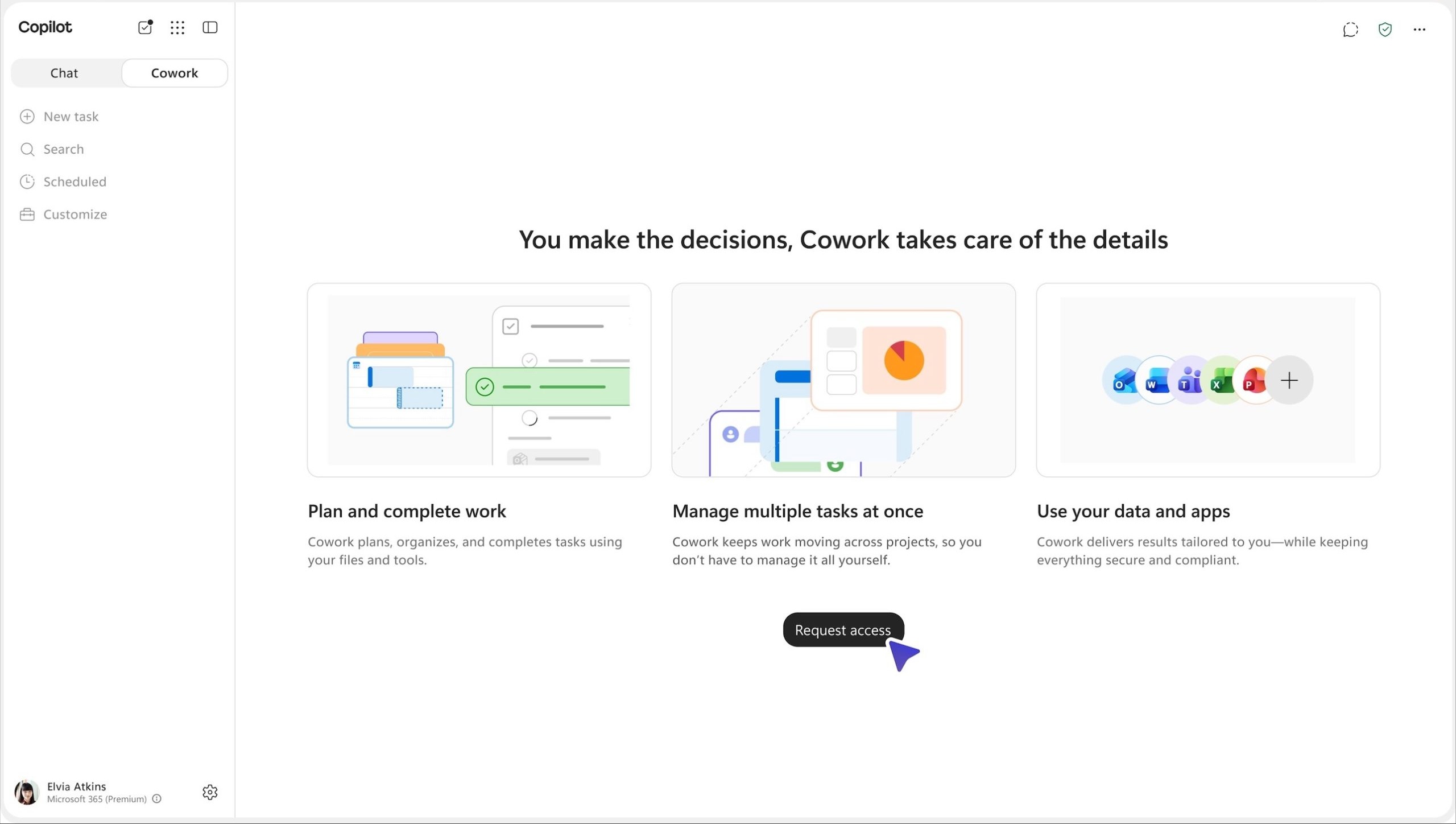
After a month, I do not see Copilot Cowork as a replacement for Copilot Chat or the in-app experiences.
I see it as another layer.
That distinction is the reality behind the excitement.
The future of AI at work is not simply better answers.
It is systems that can carry clearly defined work across tools, over time, with enough context to be useful and enough oversight to remain trustworthy.
My experiments are still evolving.
Some wishes could have been granted more cheaply elsewhere.
Others, especially the recurring job-opportunity workflow, point toward a genuinely different way of working.
The challenge now is not finding more things Cowork can do. It is learning which use cases are worth pursuing.
Because the genie is real. The only question is whether the wish is worth the cost.